
Introduction :
A bank invests millions into an AI-powered credit risk model.
The technology team builds the platform.
The data science team creates sophisticated algorithms.
The leadership team expects faster approvals, better risk prediction, and improved customer experience.
But six months later, something unexpected happens.
Business teams still hesitate to trust the recommendations.
Risk officers continue using manual checks.
Executives ask:
“Can we really depend on this data?”
This is one of the biggest reasons enterprise AI projects fail.
The problem is rarely the AI model.
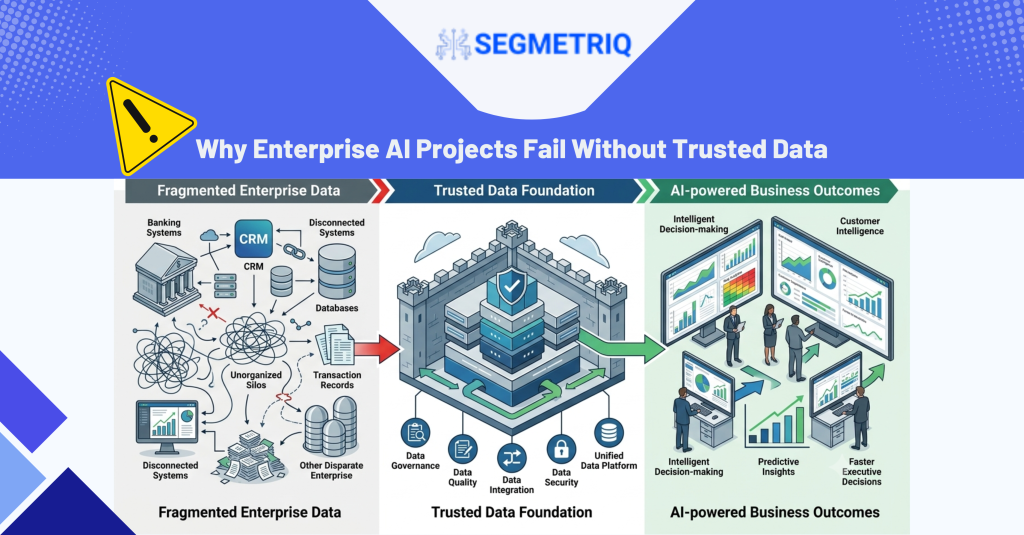
The problem is the foundation beneath it.
AI learns from data.
If the data is incomplete, inconsistent, outdated, or poorly governed, even the most advanced AI system will produce unreliable outcomes.
In today’s enterprise environment, data is no longer just a reporting asset.
It is the foundation for :
- smarter decisions
- faster customer experiences
- better risk management
- operational efficiency
- competitive advantage
Companies are investing heavily in artificial intelligence, analytics platforms, and automation.
But the organizations that succeed are not simply those with the best AI technology.
They are the ones that build trusted data ecosystems.
The Hidden Challenge Enterprises Face
Most organizations today have more data than ever before.
Customer interactions.
Transactions.
Mobile applications.
CRM systems.
Core banking platforms.
Operational systems.
Digital channels.
The challenge is not data availability.
The challenge is data confidence.
A business leader does not ask:
“How much data do we have?”
They ask:
“Can I trust this data enough to make a million-dollar decision?”
This difference changes everything.
A company may have:
- multiple databases
- hundreds of reports
- advanced dashboards
- analytics tools
- AI experiments
Yet decision-making can still remain slow.
Why?
Because data exists, but trust does not.
Data Asset vs Decision Asset
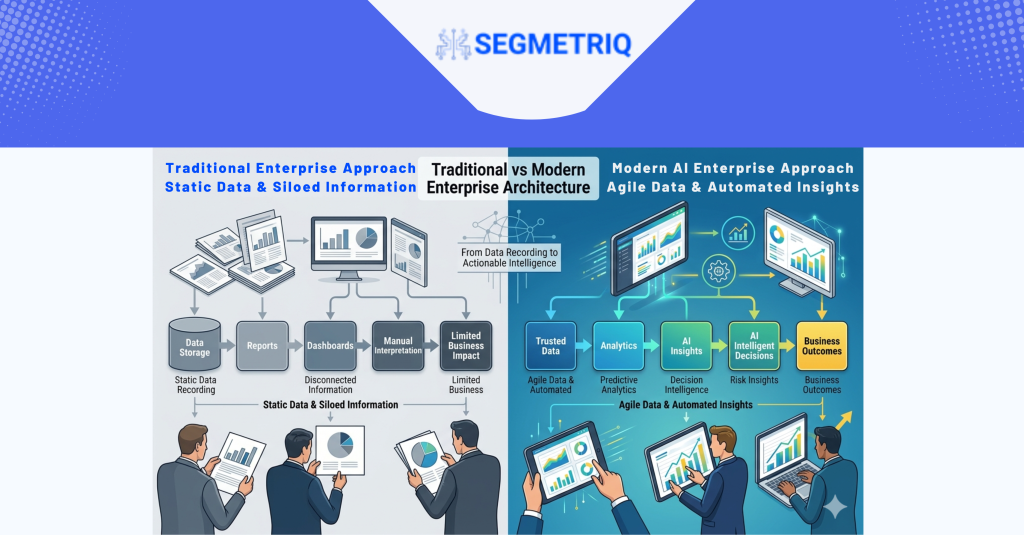
Traditional enterprises often treat data as a storage problem.
The journey looks like:
Data Storage → Reports → Dashboards → Human Interpretation
But modern AI-driven enterprises need a different approach:
Data → Insight → Decision → Business Outcome
The missing layer is decision intelligence.
This layer connects technology with business action.
Without it:
- AI recommendations are ignored
- analytics adoption decreases
- business users return to spreadsheets
- transformation projects lose momentum
Why Traditional Approaches Fail
1. Building AI Before Fixing Data Foundations
A strong analytics foundation helps organizations move from reactive reporting toward proactive decision-making through advanced data analytics solutions.
One common mistake enterprises make :
They start with AI models before preparing their data.
The assumption:
“Once we have AI, our problems will disappear.”
But AI amplifies whatever already exists.
Poor data creates poor intelligence.
For example:
A bank wants an AI model to predict customer churn.
The model needs:
- customer behaviour
- transaction history
- service interactions
- product usage
- complaints data
But if customer records are duplicated or incomplete, predictions become unreliable.
The AI model is not the problem.
The data foundation is.
2. Data Silos Create Enterprise Blind Spots
Large organizations usually have data spread across:
- core banking systems
- CRM platforms
- ERP applications
- digital channels
- external sources
Each department creates its own version of reality.
Marketing sees one customer profile.
Risk teams see another.
Operations sees another.
The result?
No single trusted customer view.
For customer intelligence and risk analytics, this creates major challenges.
3. Dashboards Are Not Always Decision Systems
Many enterprises have hundreds of dashboards.
But dashboards answer:
“What happened?”
Modern businesses need systems that answer:
“What should we do next?”
Example:
A dashboard shows increasing loan defaults.
A decision intelligence system helps identify:
- which customers are at risk
- what factors contributed
- what action should be taken
The future is moving from reporting to intelligent decision-making.
What Modern Enterprises Should Do Differently
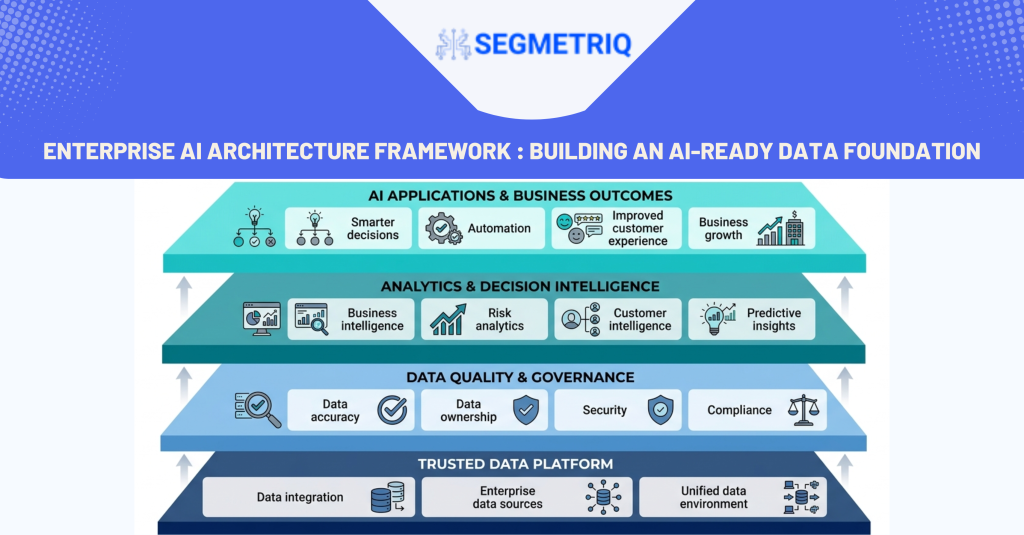
Build an AI-Ready Data Foundation
Successful AI transformation requires four layers.
Modern organizations need more than AI experiments; they need scalable AI solutions for enterprises built on trusted data foundations.
Layer 1: Data Quality
Reliable AI requires reliable inputs.
Organizations should focus on:
- accuracy
- completeness
- consistency
- timeliness
Questions leaders should ask:
- Is our customer data accurate?
- Are business definitions consistent?
- Can different teams trust the same metrics?
Layer 2: Data Governance
Enterprise AI requires strong Data governance and management practices to ensure accuracy, security, and regulatory confidence.
Governance is not about slowing innovation.
It creates confidence.
Strong governance defines:
- ownership
- accountability
- security
- compliance
- data standards
For industries like banking and NBFCs, governance becomes critical because decisions directly impact customers and regulatory requirements.
Layer 3: Analytics Foundation
AI does not replace analytics.
It builds on it.
Organizations need:
- business intelligence
- predictive analytics
- customer analytics
- risk analytics
A mature analytics foundation helps enterprises move from reactive reporting to proactive decisions.
Layer 4: Decision Intelligence
The final goal is not an AI model.
The goal is better decisions.
Decision intelligence connects:
Data + Analytics + AI + Business Context
to create measurable outcomes.
A Practical Framework : TRUST Model for AI Success
T — Trusted Data
Create reliable, governed datasets.
R — Relevant Business Context
Connect AI outputs with business objectives.
U — Unified Data Platforms
Break down fragmented data environments.
S — Scalable AI Architecture
Build systems that can grow securely.
T — Transformation Mindset
Enable teams to use intelligence in everyday decisions.
Real-World Enterprise Examples
Banking Example: AI-Based Risk Decisions
A bank wants to improve loan approval speed.
AI can analyse:
- customer history
- repayment behaviour
- transaction patterns
- financial indicators
But if the data is incomplete, risk decisions become inaccurate.
A trusted data platform enables:
- faster approvals
- improved risk assessment
- better customer experience
NBFC Example : Customer Intelligence
NBFCs manage large customer portfolios.
AI can help identify:
- repayment risks
- customer segments
- personalized offers
But success depends on having unified customer data.
Fintech Example : Scaling Personalization
Fintech companies generate massive behavioural data.
AI can improve:
- recommendations
- fraud detection
- customer engagement
But trusted data remains the foundation.
How Segmetriq Views Enterprise AI Transformation
Enterprise AI success requires more than implementing algorithms.
It requires connecting:
- data platforms
- analytics capabilities
- governance frameworks
- business decisions
Organizations need technology ecosystems where data becomes actionable intelligence.
Segmetriq Analytics works across AI, analytics, business intelligence, data management, and advanced analytics solutions to help enterprises create stronger decision-making capabilities.
Future Trends: Where Enterprise AI Is Heading
1. AI Will Move From Experiments To Enterprise Systems
Companies will shift from isolated AI pilots to integrated AI platforms.
2. Data Governance Will Become A Competitive Advantage
Organizations that trust their data will move faster.
3. Decision Intelligence Will Become Mainstream
The next generation of enterprises will not only analyse information.
They will continuously improve decisions.
Conclusion :
The biggest barrier to enterprise AI adoption is not technology.
It is trust.
AI systems can only become valuable when organizations have confidence in the data behind them.
The future belongs to enterprises that combine:
- trusted data
- strong governance
- analytics maturity
- AI capabilities
Because the ultimate goal of AI is not automation.
It is better decisions.
Connect with Segmetriq Analytics to explore how data and AI can help your organization make smarter decisions.
